 Add to Chrome
 Add to Firefox
 Add to Edge
APIOT: Autonomous Vulnerability Management Across Bare-Metal Industrial OT Networks
May 04, 2026
Bare-metal operational technology (OT) devices -- especially the microcontrollers running Modbus/TCP and CoAP at the base of industrial control systems -- have remained outside the reach of autonomous security attacks. Prior autonomous pentesting studies target Linux and web systems, whose shells and filesystems are familiar to LLM agents. Bare-metal OT has neither, so agents must reason directly over protocol fields and parser semantics. This requires new action-space designs and runtime controls, and opens new research questions about protocol-level exploit reasoning and its deployment envelope. We present APIOT (Autonomous Purple-teaming for Industrial OT), the first large language model (LLM) framework demonstrating an autonomous attack and remediation of bare-metal OT devices, achieving the full discovery -> exploitation -> patching -> verification cycle without step-by-step human intervention. We implemented and evaluated this framework on Zephyr RTOS firmware across heterogeneous industrial IoT (IIoT) topologies. Through 290 experiment runs spanning five frontier LLMs, three network topologies, two impairment levels, and guided versus unguided conditions, APIOT achieved a mission success rate of 90.0% on the full attack-remediation cycle. We found that the runtime governance layer (which we call an overseer) is a critical engineering variable: without it, agents exhibit systematic degenerate patterns, including repetition loops, missing crash verification, and reconnaissance deadlocks. Together, these findings carry two implications beyond our testbed. Attacker expertise is no longer the binding constraint on bare-metal OT exploitation, and defender threat models must now assume LLM-augmented adversaries capable of executing autonomous discovery-through-remediation cycles against industrial firmware.

xApp Distillation: AI-based Conflict Mitigation in B5G O-RAN
Jul 03, 2024The advancements of machine learning-based (ML) decision-making algorithms created various research and industrial opportunities. One of these areas is ML-based near-real-time network management applications (xApps) in Open-Radio Access Network (O-RAN). Normally, xApps are designed solely for the desired objectives, and fine-tuned for deployment. However, telecommunication companies can employ multiple xApps and deploy them in overlapping areas. Consider the different design objectives of xApps, the deployment might cause conflicts. To prevent such conflicts, we proposed the xApp distillation method that distills knowledge from multiple xApps, then uses this knowledge to train a single model that has retained the capabilities of Previous xApps. Performance evaluations show that compared conflict mitigation schemes can cause up to six times more network outages than xApp distillation in some cases.
LE3D: A Lightweight Ensemble Framework of Data Drift Detectors for Resource-Constrained Devices
Nov 18, 2022


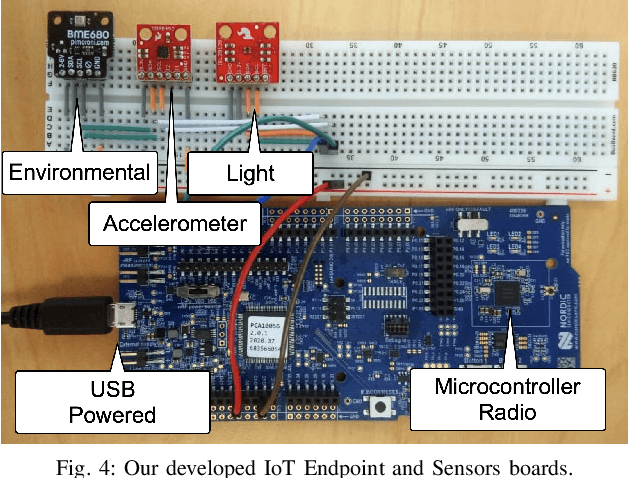
Data integrity becomes paramount as the number of Internet of Things (IoT) sensor deployments increases. Sensor data can be altered by benign causes or malicious actions. Mechanisms that detect drifts and irregularities can prevent disruptions and data bias in the state of an IoT application. This paper presents LE3D, an ensemble framework of data drift estimators capable of detecting abnormal sensor behaviours. Working collaboratively with surrounding IoT devices, the type of drift (natural/abnormal) can also be identified and reported to the end-user. The proposed framework is a lightweight and unsupervised implementation able to run on resource-constrained IoT devices. Our framework is also generalisable, adapting to new sensor streams and environments with minimal online reconfiguration. We compare our method against state-of-the-art ensemble data drift detection frameworks, evaluating both the real-world detection accuracy as well as the resource utilisation of the implementation. Experimenting with real-world data and emulated drifts, we show the effectiveness of our method, which achieves up to 97% of detection accuracy while requiring minimal resources to run.
Federated Meta-Learning for Traffic Steering in O-RAN
Sep 13, 2022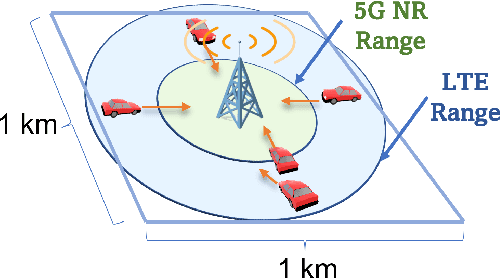
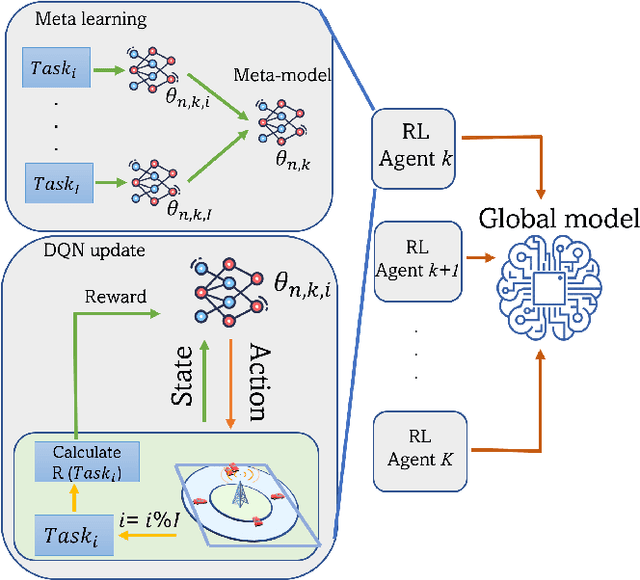
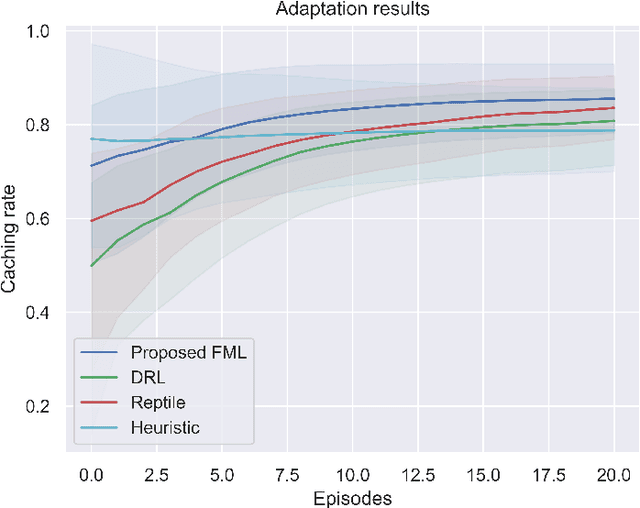
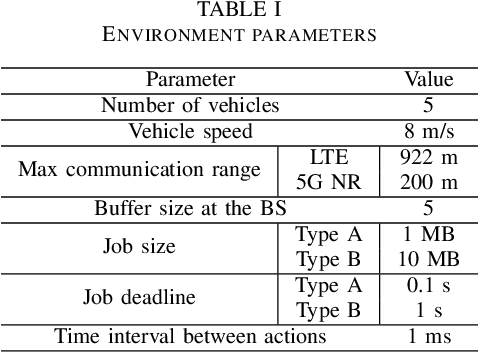
The vision of 5G lies in providing high data rates, low latency (for the aim of near-real-time applications), significantly increased base station capacity, and near-perfect quality of service (QoS) for users, compared to LTE networks. In order to provide such services, 5G systems will support various combinations of access technologies such as LTE, NR, NR-U and Wi-Fi. Each radio access technology (RAT) provides different types of access, and these should be allocated and managed optimally among the users. Besides resource management, 5G systems will also support a dual connectivity service. The orchestration of the network therefore becomes a more difficult problem for system managers with respect to legacy access technologies. In this paper, we propose an algorithm for RAT allocation based on federated meta-learning (FML), which enables RAN intelligent controllers (RICs) to adapt more quickly to dynamically changing environments. We have designed a simulation environment which contains LTE and 5G NR service technologies. In the simulation, our objective is to fulfil UE demands within the deadline of transmission to provide higher QoS values. We compared our proposed algorithm with a single RL agent, the Reptile algorithm and a rule-based heuristic method. Simulation results show that the proposed FML method achieves higher caching rates at first deployment round 21% and 12% respectively. Moreover, proposed approach adapts to new tasks and environments most quickly amongst the compared methods.